Showing posts with label pope. Show all posts
Pope Leo XIII

Pope Leo XIII


Leo XIII..jpg

Pope Leo XIII (Italian: Leone XIII), born Vincenzo Gioacchino Raffaele Luigi Pecci[a] (2 March 1810 – 20 July 1903) to an Italian comital family, reigned from 20 February 1878 to his death in 1903. He was the oldest pope (reigning until the age of 93), and had the third longest pontificate, behind that of Pius IX (his immediate predecessor) and John Paul II. He is the most recent pontiff to date to take the pontifical name of "Leo" upon being elected to the pontificate.

He is well known for his intellectualism, the development of social teachings with his famous papal encyclical Rerum novarum and his attempts to define the position of the Catholic Church with regard to modern thinking. He influenced Roman Catholic Mariology and promoted both the rosary and the scapular. He issued a record eleven encyclicals on the rosary earning the moniker the "Rosary Pope", approved two new Marian scapulars and was the first pope to fully embrace the concept of Mary as mediatrix. He was the first pope to never have held any control over the Papal States, after they were dissolved by 1870.
Leo XIII died on July 20, 1903 at the age of 93 and was briefly buried in the grottos of Saint Peter's Basilica before his remains were later transferred to the Basilica of Saint John Lateran.


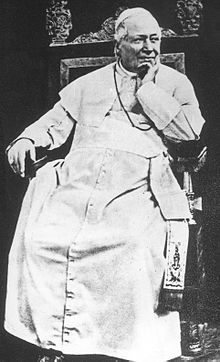
Pope Pius IX

Pope Pius IX


IX. Piusz pápa.jpg

Pope Pius IX (Italian: Pio IX; 13 May 1792 – 7 February 1878), born Giovanni Maria Mastai-Ferretti,[a] reigned from 16 June 1846 to his death in 1878. He was the longest-reigning elected pope in the history of the Catholic Church – over 31 years (the longest serving, un-elected pope was Peter the Apostle, posthumously considered the first pope, who was confirmed by Christ in 33 AD and killed by Emperor Nero in 67 AD). During his pontificate, he convened the First Vatican Council (1869–70), which decreed papal infallibility, but the council was cut short due to the loss of the Papal States.
Pius IX defined the dogma of the Immaculate Conception of the Blessed Virgin Mary, meaning that Mary was conceived without original sin. Pius IX also conferred the title Our Mother of Perpetual Help on a famous Byzantine icon from Crete entrusted to the Redemptorists.

He was also the last pope to rule as the Sovereign of the Papal States, which fell completely to the Italian army in 1870 and were incorporated into the Kingdom of Italy. After this, he was referred to – chiefly by himself – as the "Prisoner of the Vatican".
After his death in 1878, his canonization process was opened on 11 February 1907 by Pope Pius X and it drew considerable controversy over the years. It was closed on several occasions during the pontificates of Pope Benedict XV and Pope Pius XI. On 7 December 1954, Pope Pius XII re-opened the cause and Pope John Paul II proclaimed him Venerable on 6 July 1985. Together with Pope John XXIII he was beatified on 3 September 2000 after the recognition of a miracle and was assigned the liturgical feast day of February 7 which is the date of his death.


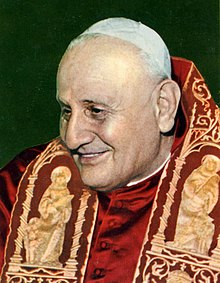
Pope Saint John XXIII

Pope Saint John XXIII


Pope John XXIII - 1959.jpg

Pope Saint John XXIII (Latin: Ioannes XXIII; Italian: Giovanni XXIII) born Angelo Giuseppe Roncalli,[a] Italian pronunciation: [ˈandʒelo dʒuˈzɛppe roŋˈkalli]; 25 November 1881 – 3 June 1963) reigned from 28 October 1958 to his death in 1963 and was canonized on 27 April 2014.[5] Angelo Giuseppe Roncalli was the fourth of fourteen children born to a family of sharecroppers who lived in a village in Lombardy.[6] He was ordained to the priesthood on 10 August 1904 and served in a number of posts, including papal nuncio in France and a delegate to Bulgaria, Greece and Turkey. In a consistory on 12 January 1953 Pope Pius XII made Roncalli a cardinal as the Cardinal-Priest of Santa Prisca in addition to naming him as the Patriarch of Venice.
Roncalli was elected pope on 28 October 1958 at age 76 after 11 ballots. His selection was unexpected, and Roncalli himself had come to Rome with a return train ticket to Venice. He was the first pope to take the pontifical name of "John" upon election in more than 500 years, and his choice settled the complicated question of official numbering attached to this papal name due to the antipope of this name. Pope John XXIII surprised those who expected him to be a caretaker pope by calling the historic Second Vatican Council (1962–65), the first session opening on 11 October 1962. His passionate views on equality were summed up in his famous statement, "We were all made in God's image, and thus, we are all Godly alike."[7] John XXIII made many passionate speeches during his pontificate, one of which was on the day that he opened the Second Vatican Council in the middle of the night to the crowd gathered in St. Peter's Square: "Dear children, returning home, you will find children: give your children a hug and say: This is a hug from the Pope!"[8]
Pope John XXIII did not live to see the Vatican Council to completion. He died of stomach cancer on 3 June 1963, four and a half years after his election and two months after the completion of his final and famed encyclical, Pacem in terris. He was buried in the Vatican grottoes beneath Saint Peter's Basilica on 6 June 1963 and his cause for canonization was opened on 18 November 1965 by his successor, Pope Paul VI, who declared him a Servant of God. In addition to being named Venerable on 20 December 1999, he was beatified on 3 September 2000 by Pope John Paul II alongside Pope Pius IX and three others. Following his beatification, his body was moved on 3 June 2001 from its original place to the altar of Saint Jerome where it could be seen by the faithful. On 5 July 2013, Pope Francis – bypassing the traditionally required second miracle – declared John XXIII a saint, after unanimous agreement by a consistory, or meeting, of the College of Cardinals, based on the fact that he was considered to have lived a virtuous, model lifestyle, and because of the good for the Church which had come from his having opened the Second Vatican Council. He was canonised alongside Pope Saint John Paul II on 27 April 2014.[9][10] John XXIII today is affectionately known as the "Good Pope" and in Italian, "il Papa buono".
The Roman Catholic Church celebrates his feast day not on the date of his death, June 3, as is usual, nor even on the day of his papal inauguration (as is sometimes done with Popes who are Saints, such as with John Paul II) but on 11 October, the day of the first session of the Second Vatican Council. This is understandable, since he was the one who had had the idea for it and had convoked it. On Thursday, 11 September 2014, Pope Francis added his optional memorial to the worldwide General Roman Calendar of saints' feast days, in response to global requests. He is commemorated on the date of his death, 3 June, by the Evangelical Lutheran Church in America and on the following day, 4 June, by the Anglican Church of Canada and the Episcopal Church (United States).[11]

Biography

Early life and ordination

Angelo Giuseppe Roncalli was born on 25 November 1881 in Sotto il Monte, a small country village in the Bergamo province of the Lombardy region of Italy. He was the eldest son of Giovanni Battista Roncalli (1854 – July 1935) and his wife Marianna Giulia Mazzolla (1855 – 20 February 1939), and fourth in a family of 13. His siblings were:
  • Maria Caterina (1877–1883)
  • Teresa (1879–1954)
  • Ancilla (1880 – 11 November 1953)
  • Francesco Zaverio (1883–1976)
  • Maria Elisa (1884–1955)
  • Assunta Casilda (Marchesi) (1886 – 23 March 1980)[12]
  • Domenico Giuseppe (22 February 1888 – 14 March 1888)
  • Alfredo (1889–1972)
  • Giovanni Francesco (1891–1956)
  • Enrica (1893–1918)
  • Giuseppe Luigi (1894–??)
  • Luigi (1896–1898)[13][14]
His family worked as sharecroppers, as did most of the people of Sotto il Monte – a striking contrast to that of his predecessor, Eugenio Pacelli (Pope Pius XII), who came from an ancient aristocratic family, long connected to the Papacy. However, he was still a descendant of an Italian noble family, from a secondary and impoverished branch.[15] In 1889, Roncalli received both his first Communion and Confirmation at the age of 8.[16]
On 1 March 1896, the spiritual director of his seminary (Luigi Isacchi) enrolled him into the Secular Franciscan Order. He professed his vows as a member of that order on 23 May 1897.[17]
In 1904, Roncalli completed his doctorate in theology[18] and was ordained a priest in the Catholic Church of Santa Maria in Monte Santo in Piazza del Popolo in Rome on 10 August. Shortly after that, while still in Rome, Roncalli was taken to Saint Peter's Basilica to meet Pope Pius X. After this, he would return to his town to celebrate mass for the Assumption.[19]

Priesthood

Roncalli (middle) in 1901.
In 1905, Giacomo Radini-Tedeschi, the new Bishop of Bergamo, appointed Roncalli as his secretary. Roncalli worked for Radini-Tedeschi until the bishop's death on 22 August 1914, two days after the death of Pope Pius X. Radini-Tedeschi's last words to Roncalli were "Angelo, pray for peace". The death of Radini-Tedeschi had a deep effect on Roncalli. [20] During this period Roncalli was also a lecturer in the diocesan seminary in Bergamo.
During World War I, Roncalli was drafted into the Royal Italian Army as a sergeant, serving in the medical corps as a stretcher-bearer and as a chaplain. After being discharged from the army in early 1919, he was named spiritual director of the seminary.[21]
On 6 November 1921, Roncalli travelled to Rome where he was scheduled to meet with the pope. After their meeting, Pope Benedict XV appointed him as the Italian president of the Society for the Propagation of the Faith. Roncalli would recall Benedict XV as being the most sympathetic of the popes he had met. [22]

Episcopate

In February 1925, the Cardinal Secretary of State Pietro Gasparri summoned him to the Vatican and informed him of Pope Pius XI's decision to appoint him as the Apostolic Visitor to Bulgaria (1925–35). On 3 March, Pius XI also named him for consecration as titular archbishop of Areopolis,[23] Jordan.[24] Roncalli was initially reluctant about a mission to Bulgaria, but he would soon relent. His nomination as apostolic visitor was made official on 19 March.[25] Roncalli was consecrated by Giovanni Tacci Porcelli in the church of San Carlo alla Corso in Rome. After he was consecrated, he introduced his family to Pope Pius XI. He chose as his episcopal motto Obedientia et Pax ("Obedience and Peace"), which became his guiding motto. While he was in Bulgaria, an earthquake struck in a town not too far from where he was. Unaffected, he wrote to his sisters Ancilla and Maria and told them both that he was fine.
On 30 November 1934, he was appointed Apostolic Delegate to Turkey and Greece and titular archbishop of Mesembria, Bulgaria.[26][27] Thus, he is known as "the Turcophile Pope," by the Turkish society which is predominantly Muslim.[28] Roncalli took up this post in 1935 and used his office to help the Jewish underground in saving thousands of refugees in Europe, leading some to consider him to be a Righteous Gentile (see Pope John XXIII and Judaism). In October 1935, he led Bulgarian pilgrims to Rome and introduced them to Pope Pius XI on 14 October.[29]
In February 1939, he received news from his sisters that his mother was dying. On 10 February 1939, Pope Pius XI died. Roncalli was unable to see his mother for the end as the death of a pontiff meant that he would have to stay at his post until the election of a new pontiff. Unfortunately, she died on 20 February 1939, during the nine days of mourning for the late Pius XI. He was sent a letter by Cardinal Eugenio Pacelli, and Roncalli later recalled that it was probably the last letter Pacelli sent until his election as Pope Pius XII on 2 March 1939. Roncalli expressed happiness that Pacelli was elected, and, on radio, listened to the coronation of the new pontiff. [30]
Roncalli remained in Bulgaria at the time that World War II commenced, optimistically writing in his journal in April 1939, "I don't believe we will have a war". At the time that the war did in fact commence, he was in Rome, meeting with Pope Pius XII on 5 September 1939. In 1940, Roncalli was asked by the Vatican to devote more of his time to Greece; therefore, he made several visits there in January and May that year.[31]

Nuncio

On 22 December 1944, during World War II, Pope Pius XII named him to be the new Apostolic Nuncio to recently liberated France.[32] In this capacity he had to negotiate the retirement of bishops who had collaborated with the German occupying power.
Roncalli was chosen among several other candidates, one of which was Archbishop Joseph Fietta. Roncalli met with Domenico Tardini to discuss his new appointment, and their conversation suggested that Tardini did not approve of it. One curial prelate referred to Roncalli as an "old fogey" while speaking with a journalist.[33]
Roncalli left Ankara on 27 December 1944 on a series of short-haul flights that took him to several places, such as Beirut, Cairo and Naples. He ventured to Rome on 28 December and met with both Tardini and his friend Giovanni Battista Montini. He left for France the next day to commence his newest role.[34]

Efforts during the Holocaust

As nuncio, Roncalli made various efforts during the Holocaust in World War II to save refugees, mostly Jewish people, from the Nazis. Among his efforts were:
  • Delivery of "immigration certificates" to Palestine through the Nunciature diplomatic courier.[35]
  • Rescue of Jews by means of certificates of "baptism of convenience" sent by Monsignor Roncalli to priests in Europe.[35]
  • Slovakian children managed to leave the country due to his interventions.[36]
  • Jewish refugees whose names were included on a list submitted by Rabbi Markus of Istanbul to Nuncio Roncalli.
  • Jews held at Jasenovac concentration camp, near Stara Gradiška, were liberated as a result of his intervention.[citation needed]
  • Bulgarian Jews who left Bulgaria, a result of his request to King Boris III of Bulgaria.[37]
  • Romanian Jews from Transnistria left Romania as a result of his intervention.[35]
  • Italian Jews helped by the Vatican as a result of his interventions.[35]
  • Orphaned children of Transnistria on board a refugee ship that weighed anchor from Constanța to Istanbul, and later arriving in Palestine as a result of his interventions.[citation needed]
  • Jews held at the Sered concentration camp who were spared from being deported to German death camps as a result of his intervention.[citation needed]
  • Hungarian Jews who saved themselves through their conversions to Christianity through the baptismal certificates sent by Nuncio Roncalli to the Hungarian Nuncio, Monsignor Angelo Rota.[35]
In 1965, the Catholic Herald newspaper quoted Pope John XXIII as saying:
We are conscious today that many, many centuries of blindness have cloaked our eyes so that we can no longer see the beauty of Thy chosen people nor recognise in their faces the features of our privileged brethren. We realize that the mark of Cain stands upon our foreheads. Across the centuries our brother Abel has lain in blood which we drew, or shed tears we caused by forgetting Thy love. Forgive us for the curse we falsely attached to their name as Jews. Forgive us for crucifying Thee a second time in their flesh. For we know not what we did.[38][39]
On 7 September 2000, the International Raoul Wallenberg Foundation launched the International Campaign for the Acknowledgement of the humanitarian actions undertaken by Vatican Nuncio Angelo Giuseppe Roncalli for people, most of whom were Jewish, persecuted by the Nazi regime. The launching took place at the Permanent Observation Mission of the Vatican to the United Nations, in the presence of Vatican State Secretary Cardinal Angelo Sodano.
Angelo Giuseppe Roncalli, Patriarch of Venice (1953–1958).
The International Raoul Wallenberg Foundation has carried out exhaustive historical research related to different events connected with interventions of Nuncio Roncalli in favour of Jewish refugees during the Holocaust. Until now,[when?] three reports have been published compiling different studies and materials of historical research about the humanitarian actions carried out by Roncalli when he was nuncio.[40][41]
In 2011, the International Raoul Wallenberg Foundation submitted a massive file (the Roncalli Dossier) to Yad Vashem, with a strong petition and recommendation to bestow upon him the title of Righteous among the Nations.[42]

Cardinal

Roncalli received a message from Mgr. Montini on 14 November 1952 asking him if he would want to become the new Patriarch of Venice in light of the nearing death of Carlo Agostini. Furthermore, Montini said to him via letter on 29 November 1952 that Pius XII had decided to raise him to the cardinalate. Roncalli knew that he would be appointed to lead the patriarchy of Venice due to the death of Agostini, who was also to be raised to the rank of cardinal.[43]
On 12 January 1953, he was appointed Patriarch of Venice and, accordingly, raised to the rank of Cardinal-Priest of Santa Prisca by Pope Pius XII. Roncalli left France for Venice on 23 February 1953 stopping briefly in Milan and then to Rome. On 15 March 1953, he took possession of his new diocese in Venice. As a sign of his esteem, the President of France, Vincent Auriol, claimed the ancient privilege possessed by French monarchs and bestowed the red biretta on Roncalli at a ceremony in the Élysée Palace. It was around this time that he, with the aid of Monsignor Bruno Heim, formed his coat of arms with a lion of Saint Mark on a white ground.
Roncalli decided to live on the second floor of the residence reserved for the patriarch, choosing not to live in the first floor room once resided in by Giuseppe Melchiorre Sarto, who later became Pope Pius X. On 29 May 1954, the late Pius X was canonized and Roncalli ensured that the late pontiff's patriarchal room was remodelled into a 1903 (the year of the new saint's papal election) look in his honor. With Pius X's few surviving relatives, Roncalli celebrated a mass in his honor.
His sister Ancilla would soon be diagnosed with stomach cancer in the early 1950s. Roncalli's last letter to her was dated on 8 November 1953 where he promised to visit her within the next week. He could not keep that promise, as Ancilla died on 11 November 1953 at the time when he was consecrating a new church in Venice. He attended her funeral back in his hometown. In his will around this time, he mentioned that he wished to be buried in the crypt of Saint Mark's in Venice with some of his predecessors rather than with the family in Sotto il Monte.


Papal styles of
Pope John XXIII
John 23 coa.svg
Reference style His Holiness
Spoken style Your Holiness
Religious style Holy Father
Posthumous style Saint


Pope Blessed Paul VI

Pope Blessed Paul VI

Pope Paul VI (Latin: Paulus VI; Italian: Paolo VI), born Giovanni Battista Enrico Antonio Maria Montini (Italian pronunciation: [dʒioˈvani baˈtista enˈriko anˈtonjo marˈija monˈtini]; 26 September 1897 – 6 August 1978), reigned from 21 June 1963 to his death in 1978. Succeeding Pope John XXIII, he continued the Second Vatican Council which he closed in 1965, implementing its numerous reforms, and fostered improved ecumenical relations with Eastern Orthodox and Protestants, which resulted in many historic meetings and agreements.[7] Montini served in the Vatican's Secretariat of State from 1922 to 1954. While in the Secretariat of State, Montini and Domenico Tardini were considered as the closest and most influential co-workers of Pope Pius XII, who in 1954 named him Archbishop of Milan, the largest Italian diocese. Montini automatically became the Secretary of the Italian Bishops Conference. John XXIII elevated him to the College of Cardinals in 1958, and after the death of John XXIII, Montini was considered one of his most likely successors.[8]

Paolovi.jpg 
Upon his election to the papacy, Montini took the pontifical name Paul VI (the first to take the name "Paul" since 1605) to indicate a renewed worldwide mission to spread the message of Christ. He re-convened the Second Vatican Council, which was automatically closed with the death of John XXIII, and gave it priority and direction. After the council had concluded its work, Paul VI took charge of the interpretation and implementation of its mandates, often walking a thin line between the conflicting expectations of various groups within Catholicism. The magnitude and depth of the reforms affecting all fields of Church life during his pontificate exceeded similar reform policies of his predecessors and successors. Paul VI was a Marian devotee, speaking repeatedly to Marian congresses and mariological meetings, visiting Marian shrines and issuing three Marian encyclicals. Following his famous predecessor Saint Ambrose of Milan, he named Mary as the Mother of the Church during the Second Vatican Council.[9] Paul VI sought dialogue with the world, with other Christians, other religions, and atheists, excluding nobody. He saw himself as a humble servant for a suffering humanity and demanded significant changes of the rich in North America and Europe in favour of the poor in the Third World.[10] His positions on birth control (see Humanae vitae) and other issues were often controversial, especially in Western Europe and North America.
Paul VI died on 6 August 1978, the Feast of the Transfiguration, in Castel Gandolfo, after a period of ill health. According to his will, he was buried in the grottos of the Vatican not in an ornate tomb, but in a grave in the ground. The diocesan process for the beatification of Paul VI began on 11 May 1993, and he was given the title "Servant of God". The diocesan process concluded its work in 1998.[11]
On 20 December 2012, Pope Benedict XVI, in an audience with the Cardinal Prefect of the Congregation for the Causes of Saints, declared that the late pontiff had lived a life of heroic virtue, which means that he could be called "Venerable".[12] A miracle attributed to the intercession of Paul VI was approved on 9 May 2014 by Pope Francis. The beatification ceremony for Paul VI was held on 19 October 2014, which means that he can now be called "Blessed".[13] His liturgical feast day is celebrated on the date of his birth, 26 September, rather than the day of his death as is usual.[14]

Early life

His father, Giorgio Montini
Giovanni Battista Montini was born in the village of Concesio, in the province of Brescia, Lombardy in 1897. His father Giorgio Montini was a lawyer, journalist, director of the Catholic Action and member of the Italian Parliament. His mother was Giudetta Alghisi, from a family of rural nobility. He had two brothers, Francesco Montini, who became a physician, and Lodovico Montini, who became a lawyer and politician.[15] On 30 September 1897, he was baptized in the name of Giovanni Battista Enrico Antonio Maria Montini.[16] He attended Cesare Arici, a school run by the Jesuits, and in 1916, he received a diploma from Arnaldo da Brescia, a public school in Brescia. His education was often interrupted by bouts of illness.
In 1916, he entered the seminary to become a Roman Catholic priest. He was ordained priest on 29 May 1920 in Brescia and celebrated his first Holy Mass in Brescia in the Basilica of Santa Maria delle Grazie.[17] Montini concluded his studies in Milan with a doctorate in Canon Law in the same year.[18] Afterwards he studied at the Gregorian University, the University of Rome La Sapienza and, at the request of Giuseppe Pizzardo at the Accademia dei Nobili Ecclesiastici. At the age of twenty-five, again at the request of Giuseppe Pizzardo, Montini entered the Secretariat of State in 1922, where he worked under Pizzardo together with Francesco Borgongini-Duca, Alfredo Ottaviani, Carlo Grano, Domenico Tardini and Francis Spellman.[19] Consequently, he spent not a day as a parish priest. In 1925 he helped found the publishing house Morcelliana in Brescia, focused on promoting a 'Christian inspired culture'.[20]

Vatican career

Polish nunciature

The only foreign diplomatic experience Montini underwent was his time in the nunciature in Warsaw, Poland in 1923. Like Achille Ratti before him,[a] he felt confronted with the huge problem, not limited to Poland, of excessive nationalism: "This form of nationalism treats foreigners as enemies, especially foreigners with whom one has common frontiers. Then one seeks the expansion of one's own country at the expense of the immediate neighbours. People grow up with a feeling of being hemmed in. Peace becomes a transient compromise between wars."[21] When he was recalled to Rome he was happy to go, because "this concludes this episode of my life, which has provided useful, though not always joyful, experiences."[22]
After his Polish mission, Giovanni Battista Montini returned to Rome, where soon he began to work in the Vatican. Later, as pope, he wanted to return to Poland on a Marian pilgrimage, but he was not permitted by the Communist government, a request that it later could not deny to the native son Karol Wojtyla, who became Pope John Paul II.

Pius XII

Montini on the day of his ordination in 1920.
His organisational skills led him to a career in the Roman Curia, the papal civil service. In 1931, Pacelli appointed him to teach history at the Papal Academy for Diplomats[18] In 1937, after his mentor Giuseppe Pizzardo was named a cardinal and was succeeded by Domenico Tardini, Montini was named Substitute for Ordinary Affairs under Cardinal Pacelli, the Secretary of State under Pope Pius XI. From Pius XI, whom he viewed with awe, he adopted the view, that learning is a life long process, and that history was the magister vitae teacher of life[23] His immediate supervisor in the Vatican was Domenico Tardini, with whom he got along well. The election of Pacelli to the papacy in 1939, anticipated by everybody and openly promoted by Pope Pius XI in his last years, was a good omen for Montini, whose position was confirmed in the position under the new Cardinal Secretary of State Luigi Maglione. He met the pope every morning until 1954 and thus developed a rather close relationship:
It is true, my service to the pope was not limited to the political or extra-ordinary affairs according to Vatican language. The goodness of Pope Pius XII opened to me the opportunity to look into the thoughts even into the soul of this great pontiff. I could quote many details how Pius XII, always using measured and moderate speech, was hiding, nay revealing a noble position of great strength and fearless courage.[24]
As war broke out, Maglione, Tardini and Montini were the main figures in the Vatican's State Department, as despatches originated from or addressed to them during the war years.[25][page needed] Montini was in charge of taking care of the "ordinary affairs" of the Secretariat of State, which took much of the mornings of every working day. In the afternoon he moved to the third floor into the Office of the Private Secretary of the Pontiff. Pius XII did not have a personal secretary. As did several popes before him, he delegated the secretarial functions to the State Secretariat.[26] During the war years, thousands of letters from all parts of the world arrived at the desk of the pope, most of them asking for understanding, prayer and help. Montini was tasked to formulate the replies in the name of Pius XII, expressing his empathy, and understanding and providing help, where possible.[26] At the request of the pope, he created an information office for prisoners of war and refugees, which in the years of its existence from 1939 until 1947 received almost ten million (9 891 497) information requests and produced over eleven million (11.293.511) answers about missing persons.[27] Montini was several times openly attacked by Benito Mussolini's government as a politician, and meddling in politics, but each time he found powerful defenses by the Vatican.[28] In 1944, Luigi Maglione died, and Pius XII appointed Tardini and Montini together as heads of the State Department. Montini's admiration was almost filial, when he described Pope Pius XII:
His richly cultivated mind, his unusual capacity for thought and study led him to avoid all distractions and every unnecessary relaxation. He wished to enter fully into the history of his own afflicted time: with a deep understanding, that he was himself a part of that history. He wished to participate fully in it, to share his sufferings in his own heart and soul.[29]
At the request of the pope, together with Pascalina Lehnert, Ferdinando Baldelli and Otto Faller, he created the Pontificia Commissione di Assistenza, which aided large number of Romans and refugees from everywhere with shelter, food and other material assistance. In Rome alone this organization distributed almost two million portions of free food in the year 1944.[30] The Vatican and the Papal Residence Castel Gandolfo were opened to refugees. Some 15,000 persons lived in Castel Gandolfo alone, supported by the Pontificia Commissione di Assistenza.[30] At the request of Pius XII, Montini was also involved in the re-establishment of Church Asylum, providing protection to hundreds of Allied soldiers, who had escaped from Axis prison camps, Jews, anti-Fascists, Socialists, Communists, and after the liberation of Rome, German soldiers, partisans and other displaced persons.[31] After the war and later as pope, Montini turned the Pontificia Commissione di Assistenza, into the major charity, Caritas Italiana.[b]

Archbishop of Milan

After the death of Cardinal Alfredo Ildefonso Schuster, OSB in 1954, Montini was appointed Archbishop of Milan, which made him the Secretary of the Italian Bishops Conference.[33] Pope Pius XII presented the new Archbishop Giovanni Battista Montini "as his personal gift to Milan". He was consecrated in Saint Peter's Basilica by Cardinal Eugène Tisserant, the Dean of the College of Cardinals, since Pius XII was forced to stay in bed due to his severe illness.
Pius XII delivered an address about Montini's appointment from his sick-bed over radio to those assembled in St. Peter's Basilica on 12 December 1954.[34] Both Montini and the pope had tears in their eyes when Montini parted for his dioceses with 1,000 churches, 2,500 priests and 3,500,000 souls.[35] On 5 January 1955, Montini formally took possession of his Cathedral of Milan. Montini, after a period of preparation, liked his new tasks as archbishop, connecting to all groups of faithful in Milan. He enjoyed meetings with intellectuals, artists and writers.[36]

Montini's philosophy

Cardinal Giovanni Battista Montini walking in Saint Peter's Square in 1962.
In his first months he showed his interest in working conditions and labour issues by personally contacting unions, associations and giving related speeches. Believing that churches are the only non-utilitarian buildings in modern society and a most necessary place of spiritual rest, he initiated over 100 new Church buildings for service and contemplation.[37]
His public speeches were noticed not only in Milan but also in Rome and elsewhere. Some considered him a liberal, when he asked lay people to love not only Catholics but also schismatics, Protestants, Anglicans, the indifferent, Muslims, pagans, atheists.[38] He engaged in friendly relations with a group of Anglican clergy visiting Milan in 1957 and a subsequently exchanged letters with the Archbishop of Canterbury, Geoffrey Fisher.[39]
He was not made a cardinal by Pius XII, who held no consistory and created no cardinals from the time he named Montini to Milan and his death four years later. Pope Pius XII revealed at the 1952 secret consistory that Montini and Tardini had declined appointments to the cardinalate.[40][41]
Montini and Angelo Roncalli were considered to be friends, but when Roncalli, as Pope John XXIII announced a new Ecumenical Council, Cardinal Montini reacted with disbelief and said to Giulio Bevilacqua: "This old boy does not know what a hornets nest he is stirring up."[42] He was appointed to the Central Preparatory Commission in 1961. During the Council, his friend Pope John XXIII asked him to live in the Vatican. He was a member of the Commission for Extraordinary Affairs but did not engage himself much into the floor debates on various issues. His main advisor was Monsignore Giovanni Colombo, whom he later appointed to be his successor in Milan[43] The Commission was greatly overshadowed by the insistence of John XXIII to have the Council complete all its work in one single session before Christmas 1962, to the 400th anniversary of the Council of Trent, an insistence which may have also been influenced by the Pope's recent knowledge that he had cancer.[44]

Pastoral progressivism

During his period in Milan, Montini was known as a progressive member of the Catholic hierarchy. Montini went new ways in pastoral care, which he reformed. He used his authority to ensure that the liturgical reforms of Pius XII were carried out at the local level and employed innovative methods to reach the people of Milan: Huge posters announced that 1,000 voices would speak to them from 10 to 24 November 1957. More than 500 priests and many bishops, cardinals and lay persons delivered 7,000 sermons in the period not only in churches but in factories, meeting halls, houses, courtyards, schools, offices, military barracks, hospitals, hotels and other places, where people meet.[45] His goal was the re-introduction of faith to a city without much religion. "If only we can say Our Father and know what this means, then we would understand the Christian faith."[46]
Pius XII asked Archbishop Montini to Rome October 1957, where he gave the main presentation to the Second World Congress of Lay Apostolate. Previously as Pro-Secretary, he had worked hard to unify a worldwide organization of lay people of 58 nations, representing 42 national organizations. He presented them to Pius XII in Rome in 1951. The second meeting in 1957 gave Montini an opportunity to express the lay apostolate in modern terms: "Apostolate means love. We will love all, but especially those, who need help... We will love our time, our technology, our art, our sports, our world."[47]
Pope Benedict XVI

Pope Benedict XVI

Pope Benedict XVI (Latin: Benedictus XVI; Italian: Benedetto XVI; German: Benedikt XVI; born Joseph Aloisius Ratzinger; German pronunciation: [ˈjoːzɛf ˈalɔʏzjʊs ˈʁatsɪŋɐ]; on 16 April 1927) served as Pope of the Catholic Church from 2005 until his resignation in 2013. Benedict was elected on 19 April 2005 in a papal conclave following the death of Pope John Paul II and was inaugurated on 24 April 2005.
Ordained as a priest in 1951 in his native Bavaria, Ratzinger established himself as a highly regarded university theologian by the late 1950s and was appointed a full professor in 1958. After a long career as an academic and professor of theology at several German universities, he was appointed Archbishop of Munich and Freising and Cardinal by Pope Paul VI in 1977, an unusual promotion for someone with little pastoral experience. In 1981, he settled in Rome when he became Prefect of the Congregation for the Doctrine of the Faith, one of the most important dicasteries of the Roman Curia. From 2002 until his election as Pope, he was also Dean of the College of Cardinals, and as such, the primus inter pares among the Cardinals. Prior to becoming Pope, he was "a major figure on the Vatican stage for a quarter of a century"; he had an influence "second to none when it came to setting church priorities and directions" as one of John Paul II's closest confidants.[2]

Image result for pope benedict xvi
He was originally a liberal theologian, but adopted conservative views after 1968.[3] His prolific[4] writings defend traditional Catholic doctrine and values. During his papacy, Benedict XVI advocated a return to fundamental Christian values to counter the increased secularisation of many Western countries. He views relativism's denial of objective truth, and the denial of moral truths in particular, as the central problem of the 21st century. He taught the importance of both the Catholic Church and an understanding of God's redemptive love.[5] Pope Benedict also revived a number of traditions, including elevating the Tridentine Mass to a more prominent position.[6] He renewed the relationship between the Catholic Church and art, promoted the use of Latin,[7] and reintroduced traditional papal garments, for which reason he was called "the pope of aesthetics".[8] He has been described as "the main intellectual force in the Church" since the mid-1980s.[9]
On 11 February 2013, Benedict announced his resignation in a speech in Latin before the cardinals, citing a "lack of strength of mind and body" due to his advanced age. His resignation became effective on 28 February 2013. He is the first pope to resign since Pope Gregory XII in 1415, and the first to do so on his own initiative since Pope Celestine V in 1294. As pope emeritus, Benedict retains the style of His Holiness, and the title of Pope, and continues to dress in the papal colour of white. He was succeeded by Pope Francis on 13 March 2013, and he moved into the newly renovated Mater Ecclesiae monastery for his retirement on 2 May 2013.

The birth house of Joseph Aloisius Ratzinger in Marktl, Bavaria

Joseph Aloisius Ratzinger was born on 16 April, Holy Saturday, 1927, at Schulstraße 11, at 8:30 in the morning in his parents' home in Marktl, Bavaria, Germany. He was baptised the same day. He was the third and youngest child of Joseph Ratzinger, Sr., a police officer, and Maria Ratzinger (née Peintner). His mother's family was originally from South Tyrol (now in Italy).[10] Pope Benedict XVI's brother, Georg Ratzinger, a priest and former director of the Regensburger Domspatzen choir, is still alive. His sister, Maria Ratzinger, who never married, managed Cardinal Ratzinger's household until her death in 1991. Their grand-uncle was the German politician Georg Ratzinger. At the age of five, Ratzinger was in a group of children who welcomed the visiting Cardinal Archbishop of Munich with flowers. Struck by the cardinal's distinctive garb, he later announced the very same day that he wanted to be a cardinal. He attended the elementary school in Aschau am Inn, which was renamed in his honour in 2009.[11]
Ratzinger's family, especially his father, bitterly resented the Nazis, and his father's opposition to Nazism resulted in demotions and harassment of the family.[12] Following his 14th birthday in 1941, Ratzinger was conscripted into the Hitler Youth—as membership was required by law for all 14-year-old German boys after March 1939[13]—but was an unenthusiastic member who refused to attend meetings, according to his brother.[14] In 1941, one of Ratzinger's cousins, a 14-year-old boy with Down syndrome, was taken away by the Nazi regime and murdered during the Action T4 campaign of Nazi eugenics.[15] In 1943, while still in seminary, he was drafted into the German anti-aircraft corps as Luftwaffenhelfer.[14] Ratzinger then trained in the German infantry.[16] As the Allied front drew closer to his post in 1945, he deserted back to his family's home in Traunstein after his unit had ceased to exist, just as American troops established a headquarters in the Ratzinger household.[17] As a German soldier, he was interned in a prisoner of war camp, but released a few months later at the end of the war in May 1945.[17]
Ratzinger and his brother Georg entered Saint Michael Seminary in Traunstein in November 1945, later studying at the Ducal Georgianum (Herzogliches Georgianum) of the Ludwig-Maximilian University in Munich. They were both ordained in Freising on 29 June 1951 by Cardinal Michael von Faulhaber of Munich. Ratzinger recalled:
...at the moment the elderly Archbishop laid his hands on me, a little bird – perhaps a lark – flew up from the altar in the high cathedral and trilled a little joyful song.[18]
Ratzinger's 1953 dissertation was on St. Augustine and was titled The People and the House of God in Augustine's Doctrine of the Church. His habilitation (which qualified him for a professorship) was on Bonaventure. It was completed in 1957 and he became a professor of Freising College in 1958.


Academic career: 1951–77

Joseph Ratzinger.jpg
This article is part of a series on the
Theology of Joseph Ratzinger
Ratzinger became a professor at the University of Bonn in 1959, his inaugural lecture was on "The God of Faith and the God of Philosophy". In 1963, he moved to the University of Münster. During this period, he participated in the Second Vatican Council (1962–65) and served as a peritus (theological consultant) to Cardinal Frings of Cologne. He was viewed during the time of the Council as a reformer, cooperating with theologians like Hans Küng and Edward Schillebeeckx. Ratzinger became an admirer of Karl Rahner, a well-known academic theologian of the Nouvelle Théologie and a proponent of church reform.
In 1966, Ratzinger was appointed to a chair in dogmatic theology at the University of Tübingen, where he was a colleague of Hans Küng. In his 1968 book Introduction to Christianity, he wrote that the pope has a duty to hear differing voices within the Church before making a decision, and he downplayed the centrality of the papacy. During this time, he distanced himself from the atmosphere of Tübingen and the Marxist leanings of the student movement of the 1960s that quickly radicalised, in the years 1967 and 1968, culminating in a series of disturbances and riots in April and May 1968. Ratzinger came increasingly to see these and associated developments (such as decreasing respect for authority among his students) as connected to a departure from traditional Catholic teachings.[19] Despite his reformist bent, his views increasingly came to contrast with the liberal ideas gaining currency in theological circles.[20]
Some voices, among them Küng, deem this a turn towards conservatism, while Ratzinger himself said in a 1993 interview, "I see no break in my views as a theologian [over the years]".[21] Ratzinger continued to defend the work of the Second Vatican Council, including Nostra aetate, the document on respect of other religions, ecumenism and the declaration of the right to freedom of religion. Later, as the Prefect of the Congregation for the Doctrine of the Faith, Ratzinger most clearly spelled out the Catholic Church's position on other religions in the 2000 document Dominus Iesus which also talks about the Roman Catholic way to engage in "ecumenical dialogue". During his time at Tübingen University, Ratzinger published articles in the reformist theological journal Concilium, though he increasingly chose less reformist themes than other contributors to the magazine such as Küng and Schillebeeckx.
In 1969, he returned to Bavaria, to the University of Regensburg and co-founded the theological journal Communio, with Hans Urs von Balthasar, Henri de Lubac, Walter Kasper and others, in 1972. Communio, now published in seventeen languages, including German, English and Spanish, has become a prominent journal of contemporary Catholic theological thought. Until his election as pope, he remained one of the journal's most prolific contributors. In 1976, he suggested that the Augsburg Confession might possibly be recognised as a Catholic statement of faith.[22][23] Several of Benedict's former students became his confidantes, notably Christoph Schönborn, and a number of his former students sometimes meet for discussions.[24][25] He served as Vice President of the University of Regensburg from 1976 to 1977.[26]

Archbishop of Munich and Freising: 1977–82

Palais Holnstein in Munich, the residence of Benedict as Archbishop of Munich and Freising
On 24 March 1977, Ratzinger was appointed Archbishop of Munich and Freising. He took as his episcopal motto Cooperatores Veritatis (Co-workers of the Truth) from 3 John 8, a choice he comments upon in his autobiographical work, Milestones. In the consistory of the following 27 June, he was named Cardinal-Priest of Santa Maria Consolatrice al Tiburtino by Pope Paul VI. By the time of the 2005 Conclave, he was one of only 14 remaining cardinals appointed by Paul VI, and one of only three of those under the age of 80. Of these, only he and William Wakefield Baum took part in the conclave.[27]

Prefect of the Sacred Congregation for the Doctrine of the Faith: 1981–2005

On 25 November 1981, Pope John Paul II, upon the retirement of Franjo Šeper, named Ratzinger as the Prefect of the Sacred Congregation for the Doctrine of the Faith, formerly known as the "Sacred Congregation of the Holy Office", the historical Roman Inquisition. Consequently, he resigned his post at Munich in early 1982. He was promoted within the College of Cardinals to become Cardinal Bishop of Velletri-Segni in 1993 and was made the college's vice-dean in 1998 and dean in 2002. Just a year after its foundation in 1990 Joseph Cardinal Ratzinger joined the European Academy of Sciences and Arts in Salzburg/Austria in 1991.[28][29]
Ratzinger defended and reaffirmed Catholic doctrine, including teaching on topics such as birth control, homosexuality and inter-religious dialogue. The theologian Leonardo Boff, for example, was suspended, while others such as Matthew Fox were censured. Other issues also prompted condemnations or revocations of rights to teach: for instance, some posthumous writings of Jesuit priest Anthony de Mello were the subject of a notification. Ratzinger and the congregation viewed many of them, particularly the later works, as having an element of religious indifferentism (i.e., Christ was "one master alongside others"). In particular, Dominus Iesus, published by the congregation in the jubilee year 2000, reaffirmed many recently "unpopular" ideas, including the Catholic Church's position that "Salvation is found in no one else, for there is no other name under heaven given to men by which we must be saved." The document angered many Protestant churches by claiming that they are not actually churches, but "ecclesial communities".[30]
Ratzinger's 2001 letter De delictis gravioribus clarified the confidentiality of internal church investigations, as defined in the 1962 document Crimen Sollicitationis, into accusations made against priests of certain crimes, including sexual abuse. This became a subject of controversy during the sex abuse scandal.[31] For 20 years, Ratzinger had been the man in charge of enforcing the document.[32] While bishops hold the secrecy pertained only internally, and did not preclude investigation by civil law enforcement, the letter was often seen as promoting a coverup.[33] Later, as pope, he was accused in a lawsuit of conspiring to cover up the molestation of three boys in Texas, but sought and obtained diplomatic immunity from liability.[34]
On 12 March 1983, Ratzinger, as prefect, notified the lay faithful and the clergy that Archbishop Pierre Martin Ngo Dinh Thuc had incurred excommunication latae sententiae for illicit episcopal consecrations without the apostolic mandate. In 1997, when he turned 70, Ratzinger asked Pope John Paul II for permission to leave the Congregation of the Doctrine of Faith and to become an archivist in the Vatican Secret Archives and a librarian in the Vatican Library, but Pope John Paul ll refused his assent.[35][36]